Posts

Showing posts with the label Lshare

Inquiry Causal Chain 2023

Image
My Causal Chain summarises how the different elements of my Inquiry connect together to work towards l ifting student achievement in reading through strengthening parent partnerships and teacher capability. The keywords that spring out are: learner achievement, learner engagement, parent partnerships, and teacher capability. The big next move is the implementation of these initiatives and measuring the impact they are having on student achievement.

Where to now... Inquiry 2023

Image
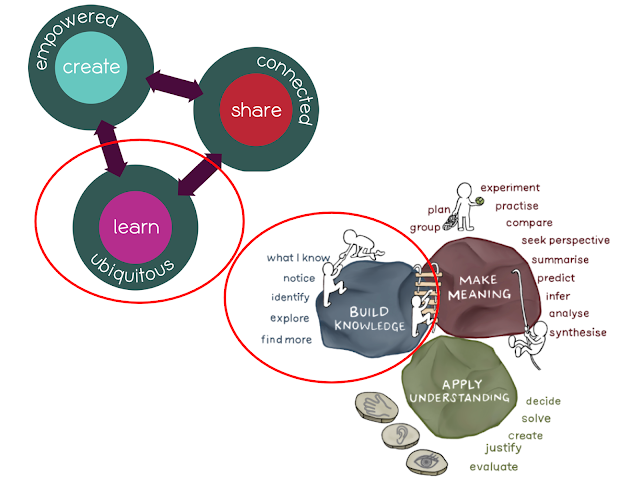
Aligning the models; Manaiakalani - Learn, Create, Share with Stonefields School - The Learning Process to base my Inquiry on strengthening whānau partnerships to lift student achievement in Reading in particular Māori and boys.  When I look at this Adaptation of 'The Educutural Wheel' Mc Farlane 2014 Whanau engagement in the education model I can see the connectedness to our Stonefields School Strategy Goal of fostering Whanau engagement and this model. The TKI MOE Website Foster whānau engagement  s uggestions for implementing the strategy ‘Building strong community networks   is a wonderful resource to give me insights on what strategies have worked,  there is a whole chapter on practical strategies to implement. I look forward to making meaning in my Y0-2 village and across the leadership team to see what is going to give us stronger whānau engagement and build relationships. 

Inquiry Summary - Burst and Bubbles 2022

Image
My child loves reading, but writing is so much harder for them. I can teach reading, but not writing. They are just not interested in writing  If they don’t know a word should I tell them or do I let them guess? Kia ora, Great to be back here to share my 2022 Inquiry. whānau voice is asking us to partner alongside to help them support their child in writing,  The data collected from earlier this year, EASTle, Overall Teacher Judgements, Gap Analysis in School Talk, Our school-wide data, and tracking attitude and confidence show there is a dip in progress and learners are not making the expected rate of shift or are below standard in writing. I saw this as an opportunity to strengthen relationships and educate whanau on how to help their child at home.  I led a parent writing workshop to upskill them on how we use the LP and to engage their child in writing. We unpacked writing samples to notice what is happening to their child. At Whānau day learners shared their writing ...

Are the connections being made? phonics to writing by using the Learning Process explicitly.

Image
 Collecting Data on what learning connections are being made? my question is how is the learning process  Split digraph a-e and ng Split digraph a-e, ee and ss Split digraph i-e and ea Student Voice: We are building our knowledge by practising our split digraph. Learners are taking action, referring to the Learning Process, and identifying the thinking skill. In this case 'Practise' to continue their learning. Taking agency to know their gaps and work on them.  Learners feeling proud of their learning when taking action to practise.  When looking at this qualitative data, I can see that the phonics we cover is transferring in most learners' writing. The noticing and reflection of this are when some learners might be writing with a different teacher and phonics are covered in reading with another teacher, can the explicit connections be made? 

Keeping lines of communication open - engaging our Whānau.

Image
  Our recent communication on our  Knowledge Builders | Tupu Mātauranga cards shares how parents can use these cards at home. Taking this a step further by engaging our whānau with the learning at school enables our whānau to feel empowered with how to use the cards. I am using these cards during reading and writing times, to provide ore practise for learners to read and spell these sight words. Learners can use these games and activities at home with their whānau. 

What Does The Research Say?...

Image
  Research Read a great article recently "The importance of Teaching and Learning in the Classroom" 2021 Some things really resonated with me. The 'Tools for transforming themselves and their world" When I think about the learning process and how it helps our learners, it is about providing tools and and a vehicle to drive learning. The next paragraphs explain that if learners are to experience success we need to consistently be reflective about what is going to help student learn best. What is going to help our learners connect to the knowledge, teach them how to think and reduce barriers to learn new knowledge.  Learning Principles “Good students are those who  learn . Whatever their preconceptions, barriers or deficits—whatever their story—they take new information and new experiences, and to the best of their ability, make them tools for transforming themselves and their world. And at last I’ve learned that a good teacher is someone who can recognize and connect ...

Term 3: Notice - Recognise - Respond

Image
Feeling refreshed and revived and ready for and new Term. Our Hub Inquiry last over the last two terms has lead to a collaborative effort to Notice - Recognise and Respond.  We have been fortunate to be fluid with our groupings. Responding to Covid times has meant that we have been more isolating to one group for all our learning areas. This term we are changing it up.  Our Writing and Maths groups are with our Guardian groups, mixed ability groupings allowing us to do buddy learning, small group, whole group a range of fluidness to meet the needs of our learners.  Our reading groups are more based on ability but allowing us to be collaborative between groups. Our Concept and Breakthrough learning is with a range of mixed learners based on learners needs and interests. I am feeling as though a weight is lifted off my shoulders and I am feeling free in my learning design to be deliberate and cause learning.  Bring in the Learning process!  To help our learners ma...

Holiday Time - keep the learning going in Writing!

Image
Holiday Time has arrived. Our mid year data across the Y1/2 cohort showed that we needed to target more of our learners to meet the national writing standards.  To cater for this need I created a 'writing ideas for home' slide to support whanāu who would like more support with how to help their child at home. Parent feedback is asking for suggestions, easy take aways and tips that can help at home. 

How does using the Learning process impact Literacy?

Image
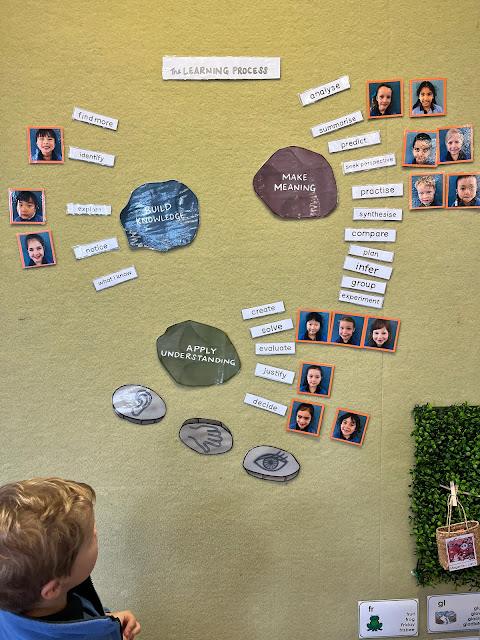
The Learning Process helps us to engage and think in our learning  We use the thinking skills to identify what we are doing to learn. Learners can talk about how they use the learning process in Writing. In summary, they comment that we use our senses to sound out the tricky words. We use 'what we know',  'notice' using the letter sound cards around us and word banks It helps us in reading when we are stuck in the Learning pit with those tricky words.  We explain how the thinking skills have helped us in writing. When I ask learners how the learning process helps you in your learning they refer to the three rocks. They have a good understanding of building knowledge. My goal is for learners to understand that the nature of working in the learning process is very fluid and not stationary in one rock. By making the learning process interactive, learners have a grater understanding of the transferability when using the learning process.   

Explicit teaching of the Learning Process

Image
  See Video of teaching practise using the Learning Process By ensuring deliberateness of teaching the Learning Process it will give learners access to know what to do when they are writing. When I ask my target learners what they find hard about writing the majority to say 'what to write', 'how to write the words' and 'what words to use.' I am noticing that learners sometimes use word cards to help them spell a word, but don't know that the Learning process can help them. Learners don't know which learning rock they are working in or what thinking skill they are using.  Over the last term I have created the visuals of the learning process to be more visible. I am explicitly using the Learning Process in writing especially (see the video that shows this).  My next step in my Inquiry is to continue this deliberateness when using the Thinking skills. By making the thinking skills visual will help learners to know how to access them and use them when they a...

Where we are at with our writing programme?

Image
Writing related to the Term 1 Concept of Well being From drafted to publised writing. Where learners are seeing the purpose and process of writing. The opportunity here to share this writing further with our Whānau for them to know where their child is at in their writing and what they could continue to support them with.  Some noticings are that learners are becoming more determined to write the sounds they can hear, knowledge of letter recognition and sounds are continued to be worked on.  The baseline data shows there are some gaps in knowledge of letter sounds and recognition. Which is a good to see where our gaps are in their phonological knowledge.  In School Talk we are a gap analysis shows there is a morning learning to do in all areas Deeper Features and Surface Features in writing.  DData and photo evidence is highlighting the opportunities and the content we can share with our whānau.