Posts

Showing posts with the label research

STOP - REFLECT - REFINE & TAKE ACTION
Image
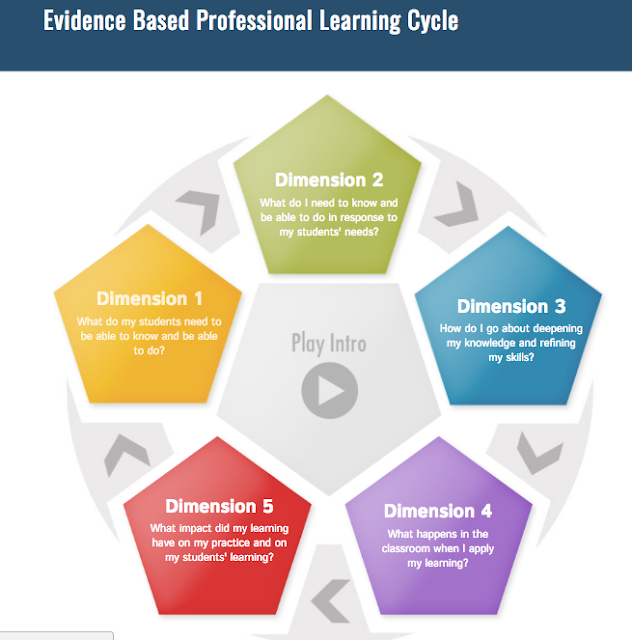
Time to dig deeper in my analysis and ask myself... "what happens in the classroom when I apply my learning" Dimension 4.    What is adaptive expertise? Adaptive expertise is about being self-aware, having agency over your ability to make a difference, and striving for the best outcomes for your students. Engaging in effective professional conversations can support you to. This video has made me look at my own practise and looking at the agency and urgency I have developed in making a difference. After having many conversations around 'Am I really making a difference". I am now able to dig deeper into my inquiry.   When reviewing Helen Timperly's research on the spiral of Inquiry I am at the checking phase now. So I am thinking about which learners are still struggling and facing some of the barriers in reading I have found.  I am wondering if my deliberate tools and strategies created and using are successfu...

Research into Quick 60

Image
Great wonderings Dorothy. 'Looks good Anita. I was wondering what you intend to do with this - or have done? Do you see similarities to Reading Recovery strategies and Quick60?' Taking this research in mind I am now using sound boxes (see past blog posts) and covering word attack skills in every reading session, as this is the foundation to reading decoding.  This is certainly what reading recovery is saying from my last visit to a reading recovery teacher last term.  Reading Recovery has more than 30 years of research and evaluation results: the strongest body of evidence for any literacy intervention. However, I am interested to learn more about Quick 60 to see how I can use the strategies with my reading.

Researching into why decode?

Image
This study is taken from Roxanne Hudson 2005 The graphs above show that Alphabetic work, word attack skills and manipulating letters is an integral part of improving reading levels, especially in years 1-3.

Research with strategies

Image
Teaching reading and viewing Guide for Years 1–3 October 2010 Excited to find some more research with practical ideas and strategies to be mindful of been thorough and highlighted what I am doing in green and what I could do more of... see next post.  

What to cover at Green Level

Image
This information from NZC Reading and Writing Standards for Y1-8 has been communicated with parents making these points explicit through using school talk learning progressions. Looking to run another Reading together workshop including and extension on how to teach HFW, phonics, decoding and comprehension activities.

Aim High!

Image
This is our aim for a majority of my readers. Two Readers have just moved to Green. Working on 16 more learners to be reading at green till the end of the term. WHAT HAS BEEN DONE SO FAR... parent voice collated, parent connects, learners more familiar with school talk and understanding where they are at with reading, knowing next steps.  Looking at how to decode (work attack) daily.  Comprehension activities regularly set during Guided Reading time.  Also, linking movement to literacy and gearing phonics programme to cover learning intentions.  WHERE TO NEXT... generate student agency for learners to take ownership of their learning and be intrinsically motivated to read. Listening to the voice of parents and their learners interests.  

My reflection: Graeme 2017 talk on Scanning Research

Image
Following on from Graeme's talk on his scanning research it is apparent that we reflect on the middle part of this model.  It is not about what our learners need to change, it is a about what can I change in my practise.   Become a vehicle for appraisal - this model is an ongoing process.  How can we move beyond this thinking that our inquiry is one big idea to a more collaborative approach not only within our hubs but across schools. I am reflecting on what is going to make our learners buzz! and have fun in their learning.

Teacher Effectiveness Rubric

Image
This T eacher effectiveness Rubric is to achieve vision aspiration. Teachers build learners through integrating and interconnecting the elements of Capacity to Learn, Capacity to Collaborate, Capacity of Making Meaning and Teacher as Inquiry. My focus areas are from Teacher as Inquiry and Assessment Capable. The green highlights where I currently and the yellow is where I want to get to.

Authenticity in my design for learning - eye tracking

Image
I have been making connections to my learning, by making reading multi-sensory, and teaching to the needs of all learners. This group of learners are building their eye strength to help them concentrate and work on their directionality for reading. I think about the whole child and what I can do to best help them how to learn.

Reading Recovery

Image
Had such a great in debt conversation with the Reading Recovery teacher at Meadowbank School.  She reiterated the benefits of using the data from 6Year Net results.  Fluency is a big umbrella in reading, that is where we want to get our learners - reading fluently.  Fluency is such a big thing, if learners are fluent will know what is going to fit in there (the unknown word) straight away. For some we need to change the mindset of texts that may not be seen as easy or one level lower than instructional level, as these texts are important for fluency and using strategies to read tricky words. This is s o important when you get up the higher levels. My take aways were using Elkonin boxes, creating fluency boxes, and getting the buy in from learners finding out about what are their passions. As of next week I will be taking the yellow and blue readers so I can continue these strategies with these learners.

Ways to hook in boys into literacy...

Image
My take  aways from here are.. *  Positive praise based on achievement and success of learning intentions, both written and verbal feedback. This will include time to reflect on the learning from the lesson.  This can be done on EE. *  Include an element of competition. *  Brisk pace of lesson. *  Variety of activities, including movement in learning. I am already well underway with linking movement to literacy.

Why lack of comprehension?

Image
Marzola 2014: Barriers of Reading, comprehension. Word identification, limited vocabulary, prior knowledge, word attack skills, comprehension strategies, thinking skills, lack of stamina and memory, lack of confidence and sense making is what I take from this.  My Inquiry looks into how to best cause shift in learning to reduce these barriers.

What does the research say?

The possible problems of lack of Comprehension are a lack of strategies.  At Stonefields School our learning progressions support the opportunity to learn strategies for reading comprehension.   Making Meaning: Comprehension Strategies Connecting, Comparing - I use my prior knowledge to make connections to what I am reading Connecting, Comparing - I make text to self, text to text and text to world connections and discuss my responses Connecting, Comparing - I can compare ideas and information in texts that are the same or different Making Meaning: Thinking Critically Predicting - I make predictions about what will happen before reading and refine them during reading Predicting - I find evidence in the text to support my predictions Predicting - I find and talk about ideas that are explicit in the text or illustrations Self Questioning - I ask questions about the purpose for reading and what the author wanted me to understand Self Questioning - I ask my self question...

Barriers in Reading - What are the road blocks?

Using 'A Moving Child is a Learning Child' I looked through what some of the barriers in reading are taking into account the whole child and how they learn.  Using a road block and road works analogy I have summarised what the barriers are that can act as a barrier to help a child learn to read.  I also shared this information at the Core Education Changing Spaces Conference.